
Showing posts with label patterns. Show all posts
Showing posts with label patterns. Show all posts
Thursday, February 27, 2014

Monday, May 6, 2013

Monday, October 8, 2012
In the Pale
White on white is eternally chic. Using a neutral palette one can still derive texture and pattern by layering different shades of white. Both in furniture and textiles white can be subtle, glossy, traditional, and contemporary.


Tuesday, June 5, 2012
Graphic Arts
From watercolors to hand illustrations, brushstrokes to Pollock like splashes, the artist studio is IN, in home décor and fashion. Color schemes are both monochromatic and rainbow like. Patterns are pixilated, faceted,
and geometric from the catwalk to the home front.


Wednesday, October 19, 2011
Speaking Squares and Rectangles
When we last analyzed stripes in our design agenda, we wondered what it would be like to analyze shapes of different kinds, so here's one on squares and rectangles.
 |
| Composition with Yellow, Blue and Red by Piet Mondrian (1937 - 1942) |
Visually, squares and rectangles have, since the beginning of pattern-making, been a prominent feature, both for their visual simplicity as well as their architectural function. Squares and rectangles as a shape are stable and they suggest honesty. They have right angles and represent order, mathematics, rationality, and formality. They are seen as earthbound. In fact the majority of text we read is set in a square or rectangle.
 | ||
| "Life Aquatic" Modern Home Decor Ultra Modern Abstract Metal Art by: Jon Allen |
Both squares and rectangles also suggest conformity, peacefulness, solidity, security, and equality. Their familiarity and stability, along with their commonness can almost seem mundane sometimes. As they are generally not attention getters, but can be tilted to add an unexpected twist. Think of web pages that tilts framed images to help them stand out and even tilts and frames in photography, cinematography etc.
 |
| NYC in squares Photograph - NYC in squares Fine Art Print - Emily J Photography |
Both shapes draw attention to the space around them and the space within, the former unlimited and the latter limited, a point of opening and convergence and metaphorically, all parallels meet in a square or rectangle. Symbolically, they represent convention, a system or a society that has a predictable manner of conduct and set rules.
 |
| Plastic disc dress, Gareth Pugh, featured in Vogue (UK), A/W'07 |
In design it these shapes bring organization through connection and separation, they symbolize ideas, create movement and texture and lead the eye from one design element to the next. This essential vocabulary is a building block of the language of design. And on rugs they do all of these to create the most exquisite patterns and designs.
An interesting video on making most of a square!
These shapes take a natural occurance in life with eveything falling into these shapes in both simple and complex form!
Text: Wooly Eyes
Images: Sources mentioned under the images
Sunday, September 18, 2011
Fascinating Lighting Experiences
So what's lighting our lives but these fascinating designs that we've been blown away by. Imagine having these in our own space. Of course with our rugs strewn on the floor and these lights overhead, it would make for pure transitional magic!
These are our four fantastic picks and they are truly inspiring:
Luisa de los Santos Robinson's Dragon's Tail Lamp is Magically Luminous


Lukas Peet’s Table Lights Shield Our Eyes From Glares


Alexandra Snook Creates Sculpturally Minimalist Furniture


Nervous System's Hyphae Lamp is Modeled After a Leaf


Aren't they all just brilliant!
Descriptive text: www.trendhunter.com
Images: www.trendhunter.com
These are our four fantastic picks and they are truly inspiring:
Luisa de los Santos Robinson's Dragon's Tail Lamp is Magically Luminous


Mythical creatures have always fascinated modern societies, especially after being popularized in such books and movies as the ‘Harry Potter’ series or even ‘Lord of the Rings’; therefore it is only natural that the Dragon’s Tail Lamp would equally fascinate us contemporary folk. It is perfect for those who are fans of such magical realms as well as households with children who have limitless imaginations.
Designed by Luisa de los Santos Robinson, the Dragon’s Tail Lamp is sharply textured, like the spiked skin of the dragons it mimics or even the crisp folds of origami art. As to the latter, this pendant light fixture does look to be made out of some kind of paper material. Available in white and parchment, the Dragon’s Tail Lamp comes in a slew of different shapes and sizes, as though actually made from real dragon tails.
Lukas Peet’s Table Lights Shield Our Eyes From Glares


Although there has been a growing appreciation for incandescent light bulbs, Lukas Peet’s Table Lights collection addresses an important criticism of these most recent redesigns. Instead of hiding them beneath lampshades, these newly artistic light bulbs have been bared for all to see, but that results in an uncomfortable glare.
Lukas Peet’s Table Lights offer an interesting solution. He has covered half of the bulbs with a mirror-like finish to shield our eyes from any unpleasant glares while also producing some stunning effects. Lukas Peet’s Spectacular model, for instance, is inspired by the reflections and rays of light, which are intensified by his strategic placement of this mirror finish. Lukas Peet’s Diffuse model, on the other hand, creates a softer illumination.
Alexandra Snook Creates Sculpturally Minimalist Furniture


Alexandra Snook creates whimsical pieces of furniture that are stunningly sculptural and yet completely practical as well. With a particular fascination with translucent white polypropylene, she creates designs that are uniquely intricate with an overall minimalist aesthetic due to her use of one color and material.
As a recent Rhode Island School of Design Master of Fine Arts graduate, Alexandra Snook’s designs are surprisingly accomplished. So much so that I wouldn’t be surprised if I saw of these lamps or seats in the window of a furniture shop sometime in the very near future.
The bends and details seen throughout Alexandra Snook’s work denote a huge amount of talent and skill, not to mention vision and determination. Alexandra Snook also designs belt buckles and necklaces.
Nervous System's Hyphae Lamp is Modeled After a Leaf


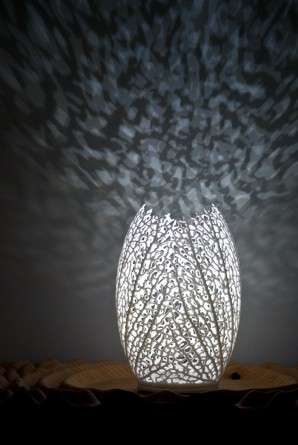
Although the Hyphae Lamp looks strikingly singular, it isn’t the first time a light fixture or even a piece of furniture has been inspired by nature (and leaves, to be more specific). There is an ethereal element to this particular design that sets it apart from other lamps that have been seen in the past.
Designed by the Nervous System studio, Hyphae Lamp was created via a complex 3D computing process, which more accurately copied the intricate details of the structure of a plant leaf so as to be more natural and unique. Even more intriguing, each Hyphae Lamp is actually grown through a controlled process based on the Auxin Flux Canalization theory, which was developed by the University of Calgary’s Algorithmic Botany group. Nervous System applied it to the Hyphae Lamp so that no two lamps are alike, a characteristic also applicable to leaves.
Aren't they all just brilliant!
Descriptive text: www.trendhunter.com
Images: www.trendhunter.com
Subscribe to:
Posts (Atom)
