
Showing posts with label rajoverseas. Show all posts
Showing posts with label rajoverseas. Show all posts
Monday, September 29, 2014

Saturday, January 11, 2014

Tuesday, July 2, 2013

Tuesday, June 18, 2013

Wednesday, January 23, 2013

Tuesday, December 4, 2012

Friday, November 2, 2012

Saturday, October 13, 2012
Tile Patterns
Flat woven rugs have had a renaissance recently in home textiles. A large influence of flatweave rugs are tile patterns. Tile patterning was originally used in antiquities in floor mosaics to depict scenes from life as well as to enrich floors. Mosaics and tile flooring has evolved and has been incorporated into decorative use in a variety of different cultures. Some of the more famous examples of tile patterning was used in the Taj Mahal as well as palaces in India. Also well known are the tiles of Portugal, Spain, Turkey and Morocco.


Thursday, October 4, 2012
Natural Fiber Rugs
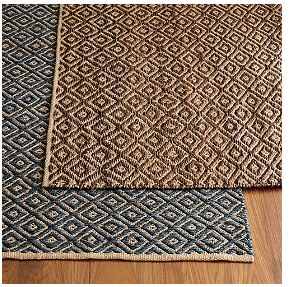
Natural Fiber Rugs have made a big revival in home décor. Jute, coir, and sisal are some of the most popular fibers currently being used in woven natural rugs. The fibers are highly sustainable and rapidly renewable resources. The fibers can be used on their own or combined with wool or cotton to create a softer hand feel. Fibers are often woven undyed but can also be dyed in wild colors to create patterns. Natural material rugs can be layered with other rugs like wool kilims or used on their own.




Saturday, August 25, 2012
Anni Albers
German-American textile artist and printmaker, Anni Albers is perhaps the best known textile artist of the 20th century.
Anni Albers came to the Bauhaus as a young student in 1922. Throughout her childhood in Berlin, she had been fascinated by the visual world, and her parents had encouraged her to study drawing and painting. Having been brought up in an affluent household where she was expected simply to continue living the sort of comfortable social life enjoyed by her mother, she showed great courage in going off to an art school where living conditions were rugged and the challenges immense. She entered the weaving workshop because it was the only one open to her, but soon found her way.
She and Josef, eleven years different in age, met shortly after her arrival in Weimar. They were married in Berlin in 1925 and Annelise Fleischmann became Anni Albers. At the Bauhaus, Anni experimented with new materials for weaving and executed richly colored designs on paper for wall hangings and textiles in silk, cotton, and linen yarns in which the raw materials and components of structure became the source of beauty.
In November 1933 Josef and Anni Albers emigrated to the USA where Josef had been asked to make the visual arts the center of the curriculum at the newly established Black Mountain College near Asheville in North Carolina. They remained at Black Mountain until 1949. Josef continued his exploration of a range of printmaking techniques and took off as an abstract painter, while continuing as a captivating teacher and writer. Anni made extraordinary weavings, developed new textiles, and taught, while also writing essays on design that reflected her independent and passionate vision. During this time Josef and Anni Albers traveled widely both in the United States and Mexico, a country that captivated their imagination and had a strong effect on both of their art. In 1950, the Alberses moved to Connecticut. Following the move, Anni Albers continued to weave, design, and write. In 1963 she happily began to explore the new medium of printmaking and produced a group of lithographs and screenprints of great spatial and textural complexity.
Her seminal text on weaving was published in 1965. Like Josef, she focused above all on her work happy to pursue it at a remove from the trends and shifting fashions of the art world. In 1984, Anni wrote, "... to comprehend art is to confide in a constant."


Wednesday, July 25, 2012
Dana Barnes
Dana Barnes is a textile designer and artist. Her work experiments with unspun natural fibers and innovative felting processes. Barnes explores different ways of forming objects using various techniques: knotting, netting, twisting and looping of fibers to create large scale textile art pieces for interior spaces. Inspired by nature, her work references thick crop fields, grazed hills and meadows, gnarled and knobby aged oak trees, and entwined and interlocked Spanish moss.


Subscribe to:
Posts (Atom)
